Vadzo Imaging Validates Dynamic ROI in the AR1335 13MP Monochrome M12 VCM USB Camera Falcon-1335MRH
Vadzo Imaging has validated Dynamic ROI operation on the Falcon-1335MRH, a 13MP monochrome USB camera product built on

Press Release Disclaimer: This is a press release distributed through the XPR Media network. It has not been independently verified by our newsroom.


Vadzo Imaging has validated Dynamic ROI operation on the Falcon-1335MRH, a 13MP monochrome USB camera product built on the Onsemi AR1335 back-side-illuminated CMOS sensor. The module pairs rolling shutter readout with software-controlled VCM autofocus on M12 optics to deliver 4K low-noise imaging across a USB 3.2 Gen 1 UVC interface. It targets machine vision, inspection, medical, retail automation, and embedded vision programs where resolution, sensitivity, and variable working distance appear in the same requirement list.
FORT WORTH, TX / ACCESS Newswire / August 28, 2026 / Vadzo Imaging, a provider of embedded and machine vision camera products for OEM programs, today confirms validation of Dynamic ROI operation on the Falcon-1335MRH AR1335 Monochrome USB Camera. The module is built on the Onsemi AR1335 Image Sensor in a monochrome configuration and combines a Voice Coil Motor autofocus assembly on M12 S-Mount optics with a USB 3.2 Gen 1 Type C interface. The result is an AR1335 Monochrome Autofocus USB Camera that resolves fine structure at 4K, holds focus across a continuous range of working distances, and streams to a host without custom driver development. Vadzo positions the module for embedded vision engineers, machine vision developers, and OEM design teams.
The Engineering Problem: Resolution, Sensitivity and Focus Rarely Coexist in One Module
Vision system designers working at 13MP meet a recurring conflict. Higher resolution on a fixed optical format means smaller pixels, and smaller pixels collect fewer photons per exposure. A lower photon count means a lower signal-to-noise ratio, which forces the designer to add illumination, extend exposure, or accept noisier frames entering the measurement stage. Each response costs money, introduces motion blur, or degrades every algorithm that depends on edge contrast.
A second conflict is focus. Fixed focus optics are simple and mechanically stable, but they lock the system to one calibrated working distance. The moment a part height changes or a document is placed inconsistently, the module loses sharpness at exactly the moment the image matters. Teams then choose between multiple lens variants or a motorized focus mechanism controlled from the host.
A third conflict is interface bandwidth. A 13MP frame carries a large payload, and streaming it continuously consumes USB bandwidth, host memory, and inference cycles even when the region of interest occupies a small part of the array. Many deployments need full detail inside a defined window that moves under software control. The Falcon-1335MRH resolves all three conflicts in a single 13MP USB Camera module rather than across separate hardware variants.
Engineering Rationale: Why Monochrome Capture Changes the Photon Budget
A color image sensor places a Bayer color filter array over the pixel grid, so each pixel receives only the fraction of incident light that passes through its assigned red, green, or blue band. The missing channels at each location are then reconstructed by demosaicing in the image signal processor. Two costs follow. The filter attenuates light before it reaches the photodiode, and demosaicing interpolates values that were never measured, which softens edges and introduces color artifacts along high-contrast transitions.
A monochrome sensor removes the color filter array from the stack. Every pixel captures the full visible spectrum reaching it, and every value in the output frame is a measured sample rather than an interpolated one. For monochrome imaging, this produces two outcomes that matter at the algorithm level. Sensitivity improves because more photons per pixel reach the photodiode within the same exposure window. True spatial resolution improves because edge position is derived from measured samples across the full pixel grid instead of a reconstructed color mosaic. In inspection, metrology, and reading pipelines, this is why a High Resolution Monochrome Machine Vision Camera architecture is frequently the correct choice where color carries no diagnostic value.
These outcomes compound at 13MP. The Onsemi AR1335 uses a 1.1 micron pixel on a 1/3.2 inch optical format, which is a small pixel by machine vision standards. Removing the color filter array recovers a meaningful part of the photon budget that a small pixel cannot afford to lose, which is what makes a 4K Low Noise Monochrome Camera practical at this pitch. The AR1335 also uses a back-side-illuminated structure that moves the wiring layers behind the photodiode, so incident light reaches the photosensitive area without passing through metal interconnects.
Product Overview: Falcon-1335MRH Sensor and Camera Architecture
The Falcon-1335MRH is built on the Onsemi AR1335, a 1/3.2-inch back-side-illuminated CMOS image sensor with a 1.1-micron pixel pitch and a maximum resolution of 13MP at 4208 x 3120. In this module, the sensor is deployed in a monochrome configuration with a rolling shutter readout architecture. Full 4K output is supported, which positions the module as an AR1335 4K USB Camera for pipelines already built around 3840 x 2160 frame geometry. This resolution places the module within Vadzo’s high-resolution USB camera module range built for OEM programs that need pixel-level detail beyond standard definition. The sensor is the same imaging core Vadzo has qualified across its 13MP USB 3.2 Camera programs, which shortens evaluation for teams that already assessed the color variant.
On the camera side, the module uses an M12 Standard S-Mount lens holder with an integrated Voice Coil Motor autofocus assembly. Focus position is set by the host over software rather than by mechanical adjustment at the lens barrel. The interface is USB 3.2 Gen 1 over Type-C with full UVC class compliance, so the AR1335 Monochrome USB Camera enumerates as a standard video capture device on Windows, Linux, and Android hosts. Dynamic ROI is validated on this module, so the host can define and relocate a region of interest at runtime. The VISPA ARC SDK provides access to focus control, region of interest configuration, exposure, and streaming parameters beyond the UVC baseline.
Key specs: 13MP (4208 x 3120) | Onsemi AR1335 1/3.2″ BSI CMOS | Monochrome | 1.1 µm x 1.1 µm Pixel Size | Rolling Shutter | VCM-Based Autofocus (Software Controlled) | S Mount (M12 Standard) | USB 3.2 Gen 1 Type C | UVC Compliant, RoHS 3, REACH | Dynamic ROI | Windows, Linux, Android (Need additional SDK)
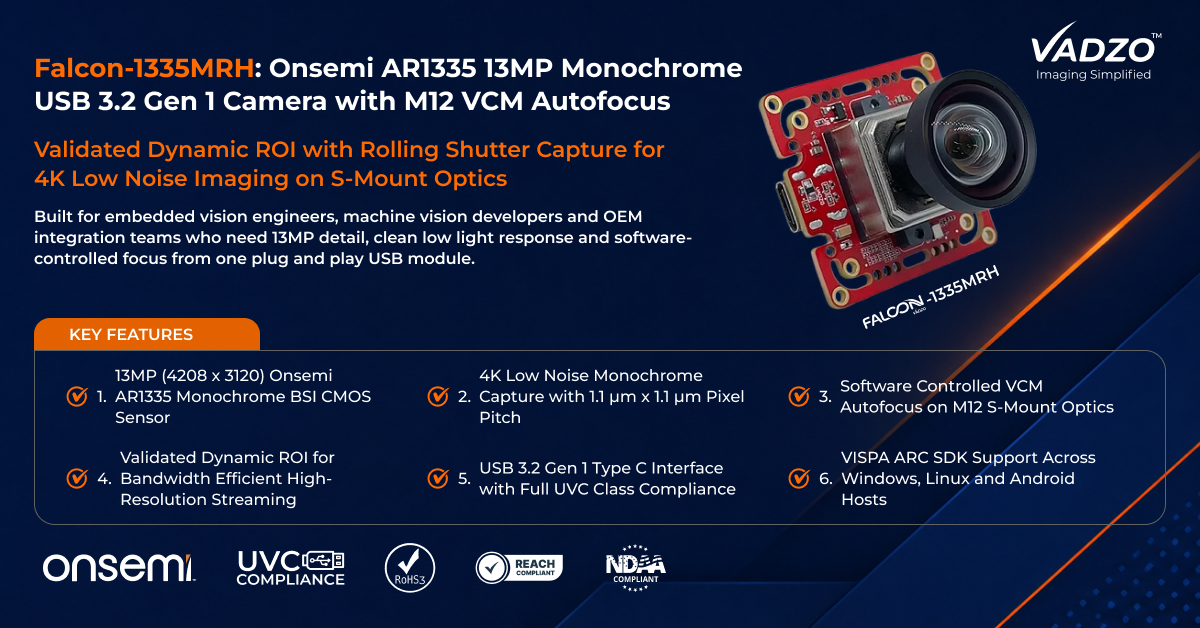
Key Capabilities of the Falcon-1335MRH Onsemi AR1335 13MP Monochrome USB 3.2 Gen 1 Camera
Validated Dynamic ROI for Bandwidth-Efficient High-Resolution Capture: Dynamic ROI allows the host application to select a subregion of the sensor array, stream only that window, and then move or resize it at runtime without reinitializing the stream. The engineering value is not cropping, which the host can perform after the frame arrives. The value is that discarded data never leaves the camera, so it never enters the USB payload, the host DDR traffic, or the inference input tensor. A Dynamic ROI USB Camera therefore operates at full native detail inside the window that matters while leaving interface headroom for other subsystems on the same host.
In practice, a label reading station needs full detail across the label and nothing outside it. A bond inspection cell needs the bond site at native resolution and nothing else. A Dynamic ROI Machine Vision Camera handles both without a resolution compromise, because the window is defined in sensor coordinates rather than rebuilt from a downscaled frame. Validation on the Falcon-1335MRH means the region can be repositioned as the target moves through the field of view, which makes the feature usable in production rather than only in a static setup.
Software Controlled M12 VCM Autofocus on S-Mount Optics: The module integrates VCM autofocus through an M12 Standard S-Mount lens holder. A Voice Coil Motor moves the lens element along the optical axis in response to current applied to a small electromagnetic coil, repositioning the focal plane in milliseconds without mechanical intervention. Because focus is commanded over software, the host drives it as part of the imaging pipeline rather than as a fixed setup parameter. Teams evaluating focus architecture can review how VCM autofocus systems work before committing to a design.
This removes the principal limitation of fixed focus deployment, which is that a single calibrated working distance becomes the ceiling of deployment flexibility. In document capture, paper is not always placed at the same position. In laboratory imaging, sample carriers sit at different heights. In inspection, part geometry changes between runs. An M12 VCM Autofocus Camera handles these conditions with one module and one software interface, and the resulting AR1335 M12 USB Camera configuration removes the recalibration step between deployments. The S-Mount holder also keeps focal length selection independent of the focus mechanism, which makes the AR1335 S-Mount USB Camera adaptable across product variants that share electronics but require different fields of view. This pairing of resolution and continuous focus is available as an AR1335 4K Autofocus USB Camera for OEM teams that need continuous autofocus on a 4K capture pipeline.
Onsemi AR1335 Monochrome Sensor for Low Noise 4K Capture: The Onsemi AR1335 delivers 13MP at 4208 x 3120 from a 1/3.2 inch back-side-illuminated array with a 1.1 micron pixel pitch. The back-side-illuminated structure places metal interconnect behind the photodiode so incident light is not obstructed by wiring. This improves quantum efficiency relative to a front-side-illuminated design at the same pitch, keeping the sensor usable at 13MP on a compact optical format. Combined with monochrome capture, the result is a Low Noise Machine Vision Camera that holds usable contrast where a small pixel color sensor would require supplementary lighting.
The benefit is most visible in the shadow region of the histogram. Read noise and photon shot noise dominate at low signal levels, and any additional attenuation in the optical stack pushes more of the scene into that regime. Removing the color filter array raises signal at every pixel and moves the usable portion of the scene further above the noise floor. In enclosed inspection cells, laboratory instruments, and indoor infrastructure, this AR1335 Monochrome USB Camera architecture allows shorter exposures at the same image quality, which reduces motion blur without adding illumination hardware. The same applies to any 13MP 4K USB Camera deployment where illumination is fixed by the environment.
Rolling Shutter Readout and Where It Is the Correct Engineering Choice: Rolling shutter sensors expose and read the pixel array row by row, so each row is captured at a slightly different instant. In scenes with fast relative motion, this produces skew and geometric distortion. Where the subject is static during exposure or moving slowly relative to the readout period, rolling shutter carries no measurement penalty and delivers a real advantage in pixel design, because the simpler pixel structure permits higher resolution on a smaller optical format at lower cost and power than a global shutter array of equal pixel count.
That trade-off is why a 13MP Rolling Shutter USB Camera is the appropriate architecture for document capture, static part inspection, laboratory imaging, and dimensional verification on indexed stages. Vadzo publishes global shutter camera products for motion-critical work and rolling shutter products where resolution and sensitivity take priority, so selecting the AR1335 Rolling Shutter USB Camera architecture is a deliberate design decision rather than a compromise. Pairing that readout with software-controlled focus produces an AR1335 Autofocus Rolling Shutter USB Camera suited to variable distance capture of presented targets, and the same 13MP Autofocus Rolling Shutter USB Camera configuration supports 4K workflows as an AR1335 4K Rolling Shutter USB Camera without changing the optical stack.
USB 3.2 Gen 1 Type-C with Full UVC Class Compliance: The module connects over USB 3.2 Gen 1 using a Type-C connector. Full UVC compliance means the operating system recognizes it as a standard video input device on connection and streams immediately without custom driver installation. Windows provides native UVC support in its inbox driver stack, Linux exposes the device through the V4L2 framework, and Android includes a UVC host driver in the platform. Teams unfamiliar with the class specification can review how a UVC camera works before scoping integration. This class-compliant behavior places the Falcon-1335MRH within Vadzo’s UVC USB camera products range built for OEM teams that standardize on driverless integration.
For OEM programs, this removes driver development from the integration scope and removes driver compatibility risk across operating system updates, which is a recurring maintenance cost in long-lifecycle products. The single cable architecture also carries power from the host. Vadzo maintains a broader USB 3 UVC camera portfolio across resolutions and shutter types, and this AR1335 USB 3.2 Camera sits at the high-resolution monochrome end of that lineup. Programs that standardize on a lower resolution pipeline can draw from the 1080p Full HD USB camera module range using the same class-compliant integration path.
Product Specifications
|
Parameter |
Specification |
|
Camera Model |
Falcon-1335MRH |
|
Image Sensor |
AR1335 CMOS Sensor from Onsemi |
|
Sensor Type |
Back Side Illuminated CMOS |
|
Color Configuration |
Monochrome |
|
Optical Format |
1/3.2″ |
|
Pixel Size |
1.1 µm x 1.1 µm |
|
Resolution |
13MP (4208 x 3120) 4K |
|
Shutter Type |
Rolling Shutter |
|
Focus Type |
VCM-Based Autofocus (Software Controlled) |
|
Lens Mount |
S Mount (M12 Standard) with VCM Autofocus |
|
Interface |
USB 3.2 Gen 1 Type-C Interface Backward Compatible with USB 3.0 |
|
Class Compliance |
UVC (USB Video Class) |
|
Region of Interest |
Dynamic ROI |
|
Operating Systems |
Windows, Linux, Android |
|
SDK Support |
VISPA ARC SDK (C, C++, C# and Python) |
“Engineering teams keep arriving at the same request. They want 13MP of real detail, clean in the light they actually have, with focus that follows the target instead of dictating where the target sits. The Falcon-1335MRH answers all three. Removing the color filter array recovers sensitivity a 1.1 micron pixel cannot afford to lose; the VCM assembly on M12 optics removes the fixed working distance constraint, and validated Dynamic ROI lets the host pull full native detail from the window that matters. It is a module built for measurement, reading, and inspection rather than a general-purpose camera.” – Alwin Vincent, Product Manager, Vadzo Imaging.
Target Applications
Industrial Inspection, Metrology and Machine Vision: Automated optical inspection depends on edge contrast. Solder joint verification, connector pin presence checks, surface defect detection, and dimensional measurement all reduce to locating boundaries with subpixel confidence. Monochrome capture supports this because every pixel carries a measured intensity rather than a demosaiced estimate, which stabilizes gradient calculation along the edge. At 13MP, the module resolves fine geometry across a wide field of view, so one station inspects a full assembly rather than indexing across capture positions, and a 13MP 4K Rolling Shutter USB Camera on an indexed stage captures presented parts without a readout penalty. For automation and robotics vision cells, the 13MP Monochrome VCM Autofocus USB Camera architecture removes the lens change when part height varies between production runs, because focus stays under host software control.
Optical Character Recognition, Barcode Reading and Retail Automation: Reading applications are unforgiving about focus and resolution. Optical character recognition accuracy falls when stroke edges soften, and code decoding depends on resolution measured in pixels per code element. A 13MP Autofocus USB Camera addresses both at once, because focus compensates for inconsistent presentation distance while the array supplies enough pixels per character to decode reliably. Monochrome capture further improves decode margin on low-contrast printing and direct part marking, where color contributes nothing and demosaicing reduces edge definition. In retail automation deployments including self-checkout, shelf audit and returns processing, this reduces failed read events, and in kiosk and digital signage terminals the same 13MP 4K Autofocus USB Camera handles document scanning and identity capture at the varying distances users present.
Medical Devices, Laboratory and Life Science Imaging: Instrument imaging in diagnostics, assay readers, and sample handling systems operates under illumination constraints set by the sample. Transmitted light and fluorescence adjacent workflows sit at low signal levels where optical attenuation is expensive. Removing the color filter array raises signal at the photodiode, which permits shorter integration times on light-sensitive preparations. The array resolves fine morphological structure without upscaling, and focus compensates for variation in carrier height without operator adjustment between runs. For medical device and patient care platforms, the 13MP Monochrome Rolling Shutter USB Camera architecture suits stationary sample capture where readout timing carries no measurement penalty, and the class-compliant interface simplifies software validation because no proprietary driver enters the stack.
Security, Surveillance and Smart City Infrastructure: Identity capture, license plate recognition and forensic review value luminance detail over color fidelity. A monochrome sensor delivers more usable detail per photon under street lighting, parking structures, and indoor entrances, where a color sensor of the same pitch would need gain that amplifies noise into the recognition pipeline. An AR1335 Monochrome Rolling Shutter USB Camera covers a wide scene with enough pixel density for plate character reading at the far end, and Dynamic ROI pulls a full-resolution window from the region containing the plate while the wider view serves situational context. For security and surveillance installations and smart city solutions nodes, a 13MP VCM Autofocus USB Camera simplifies commissioning, because an AR1335 VCM Autofocus Rolling Shutter USB Camera is focused over software rather than by a technician at the bracket.
Fleet Telematics, In-Cabin Monitoring and Transportation Systems: Vehicle-mounted imaging faces variable illumination across tunnels, night operation, and direct sun, and the mechanical environment makes manual focus adjustment a service liability. Monochrome sensitivity improves capture margin at night, and software-controlled focus lets a fleet operator correct focus across a deployed population without physical access to each vehicle. A 13MP VCM Autofocus Rolling Shutter USB Camera supports driver monitoring, cargo verification, and load area viewing, and the AR1335 Monochrome VCM Autofocus USB Camera build keeps that capability in one part number across vehicle types. For telematics and fleet management programs, the class-compliant interface attaches to the existing telematics compute unit without driver certification, and Vadzo supports custom OEM camera configurations where mounting, cable length, or optics must match a specific vehicle platform.
VISPA ARC SDK and Developer Integration
The Falcon-1335MRH is supported by the Vadzo VISPA ARC SDK, which provides programmatic control over streaming, region of interest configuration, exposure, gain, autofocus behavior, image flip, still capture, and secure firmware update. APIs are available in C, C++, C# and Python across Windows, Linux and embedded platforms. For development teams, the value is that Dynamic ROI and focus control on the AR1335 VCM Autofocus USB Camera are addressable from application code rather than fixed at manufacture, so window position and focus policy can be tuned per deployment and updated in the field through a software release.
Because the module streams as a UVC device without the SDK present, teams begin evaluation using standard capture tools and add SDK-level control only where the application requires it. This two-stage path shortens evaluation and preserves plug-and-play behavior for standard streaming. The SDK presents a consistent control interface across the wider Vadzo USB 3.2 Gen 1 range, simplifying lifecycle management for teams maintaining several configurations. Architects can also review how an embedded vision camera operates in automation and robotics before finalizing the software stack.
Frequently Asked Questions
Q: Why does a monochrome image sensor deliver better low light performance than a color sensor with the same resolution?
A: A color sensor places a Bayer color filter array over the pixel grid so each pixel receives only red, green, or blue light. The filter attenuates light before it reaches the photodiode, and the missing channels are reconstructed by demosaicing rather than measured. A monochrome sensor removes that layer, so every pixel collects the full spectrum reaching it, and every output value is a measured sample. The result is higher signal per pixel at the same exposure and truer edge resolution, because edge position comes from real samples rather than interpolated estimates.
The advantage grows as pixel pitch shrinks, because a small pixel already has a limited photon count and any attenuation pushes more of the scene toward the noise floor. Vadzo Imaging built the Falcon-1335MRH around this reasoning, pairing the monochrome Onsemi AR1335 array at 1.1 micron pitch with M12 VCM autofocus over USB 3.2 Gen 1. The result is a 13MP 4K Monochrome USB Camera that holds usable contrast in enclosed inspection cells, laboratory instruments, and indoor infrastructure without supplementary illumination hardware. Teams new to the trade-off can review the Vadzo guide on monochrome imaging for a comparison against color capture.
Q: What is Dynamic ROI in a USB camera and how does it reduce bandwidth and latency?
A: Dynamic ROI is the ability to define a region of interest in sensor coordinates, stream only that region, and then move or resize it at runtime under software control. It differs from host-side cropping, where the full frame still crosses the interface and is written into host memory before unwanted pixels are discarded, consuming bandwidth and memory traffic regardless. With Dynamic ROI, the pixels outside the window are never transmitted, which reduces USB payload, host DDR bandwidth, buffer copy cost, and the size of the tensor entering an inference model.
The effect is direct. A smaller readout window reduces per-frame transfer time, lowering latency between event and decision and freeing interface headroom for other devices on the host controller. Vadzo Imaging has validated Dynamic ROI on the Falcon-1335MRH, making it an AR1335 Dynamic ROI Camera suited to label reading, bond site inspection, plate capture, and any workflow needing full detail inside a moving window. Because window position is commanded through the VISPA ARC SDK, integrators tie region placement to an upstream detector or to encoder position on a conveyor.
Q: How does VCM autofocus work on an M12 S-Mount lens and when should it be chosen over fixed focus?
A: A Voice Coil Motor autofocus assembly suspends the lens element on a spring-loaded carrier surrounded by an electromagnetic coil. Applying current produces a linear force that displaces the carrier along the optical axis and shifts the focal plane, and removing current returns the carrier toward its rest position. The movement is fast, repeatable, and free of gear backlash, which is why the architecture suits compact modules where a stepper-driven helicoid would be too large. Focus position is set by an internal contrast detection routine or commanded from the host, so focus becomes a pipeline parameter rather than a fixed setup value.
Fixed focus is correct when working distance is mechanically constrained and never changes, for example, an inspection station where part height is set by a hard stop. Autofocus becomes necessary the moment presentation distance varies, which covers document capture, laboratory carriers of different heights, entrance systems, and cells handling multiple part geometries. An M12 holder keeps focal length selection independent of the focus mechanism, which is why a 13MP M12 USB Camera built on a 13MP S-Mount USB Camera holder serves several product variants. A detailed explanation of focus architectures is available in the Vadzo guide on autofocus and VCM technology.
Q: Which 13MP monochrome USB camera is best suited for inspection, optical character recognition and laboratory imaging?
A: The right module for these workloads satisfies several requirements at once. It needs enough resolution to resolve small features and character strokes without upscaling, monochrome capture for clean edge gradients, focus that adapts to variable presentation distance, windowing that keeps processing load proportional to the region under evaluation, and a class-compliant interface that integrates without driver work.
The Vadzo Imaging Falcon-1335MRH meets all of these on one module. It is built on the Onsemi AR1335 in a monochrome configuration, delivering 13MP at 4208 x 3120 with 4K output, uses software-controlled VCM autofocus on M12 optics, and streams over a UVC-compliant USB 3.2 Gen 1 Type-C interface with validated Dynamic ROI. As an integration-ready 13MP Monochrome Autofocus USB Camera, it suits automated optical inspection, code and character reading, assay and sample imaging, and dimensional verification on indexed stages. Related options across the high-resolution USB camera module range and the broader 4K camera portfolio cover teams needing color capture, a different shutter architecture, or optical format on the same integration path.
Q: Does a UVC-compliant USB 3.2 camera stream on Windows, Linux, and Android without custom drivers?
A: Yes. USB Video Class is a standard device class defined within the USB specification, and the major operating systems include a UVC host driver in their default stack. Windows recognizes UVC devices through its inbox driver from Windows 7 onward, Linux exposes them through V4L2 in the mainline kernel, and Android includes UVC host support in the platform. When a compliant module is connected, it enumerates as a standard video capture device available to any application that can open a video input, with streaming formats advertised by the device itself.
This matters for OEM schedules because driver development and maintenance leave the integration scope, and operating system updates do not create a compatibility risk in long lifecycle products. The Vadzo Imaging Falcon-1335MRH is a fully class-compliant AR1335 USB Camera that streams on connection, with the VISPA ARC SDK available separately for focus control, Dynamic ROI configuration, and firmware updates. Vadzo also publishes a UVC USB camera technical explainer covering what the class specification does and does not define.
Availability and Customization
The Falcon-1335MRH Onsemi AR1335 13MP Monochrome USB 3.2 Gen 1 Camera with M12 VCM Autofocus is available now for evaluation and pre-production sampling, with production quantities for OEM deployment. The AR1335 Monochrome USB Camera ships in the same 13MP configuration validated for Dynamic ROI, and the AR1335 4K VCM Autofocus USB Camera build is available under the same part number for OEM programs consolidating on one 4K platform. Engineering teams evaluating an AR1335 Autofocus USB Camera can request the technical datasheet, mechanical drawings, and SDK documentation through the AR1335 4K Monochrome USB Camera product page. Evaluation units can be ordered directly from the Vadzo online store. Custom configurations covering optics selection, form factor modification, connector changes, firmware customization, and sensor integration are supported for volume programs. For pricing, customization scoping, or integration assistance, teams can reach Vadzo through contact support.
About Vadzo Imaging
Vadzo Imaging develops embedded and machine vision camera products for OEMs and system integrators building production-ready vision systems across industrial automation, robotics, healthcare, and smart infrastructure. The company’s imaging platforms span USB, MIPI, GigE, Wi-Fi, and SerDes interfaces, covering embedded deployment architectures from compact edge devices to distributed networked systems. Beyond hardware, Vadzo provides end-to-end imaging support including sensor integration, ISP tuning, firmware development, and SDK frameworks, giving engineering teams one partner from evaluation through production lifecycle management.
Media Contact
Alwin Vincent
Vadzo Imaging
Email: alwin@vadzoimaging.com
LinkedIn: Vadzo Imaging
YouTube: Vadzo Imaging
X: Vadzo Imaging
SOURCE: Vadzo Imaging
View the original press release on ACCESS Newswire
Media gallery