
Playroom Architect Explains How Product Labels Should Shape Art and Craft Stations at Home
New York, New York - September 25, 2026 - PRESSADVANTAGE - Following a September 4, 2026 report from the nonprofit

Press Release Disclaimer: This is a press release distributed through the XPR Media network. It has not been independently verified by our newsroom.

New York, New York – September 25, 2026 – PRESSADVANTAGE –
Following a September 4, 2026 report from the nonprofit Defend Our Health, which reviewed manufacturer disclosures in the IC2 High Priority Chemicals Data System (HPCDS) and noted that several major brands had disclosed formaldehyde or other chemicals of concern in children’s products, including items connected with school and art supplies, Playroom Architect has offered a systems-planning perspective for parents organizing home art spaces during the back-to-school season.
The HPCDS itself states that the presence of a reported chemical does not necessarily mean a product is harmful or violates safety standards, and that its reporting triggers are not health-based thresholds. The database exists to collect manufacturer reports required by programs in states including Oregon, Washington and Vermont. Playroom Architect emphasized that the disclosure discussion is useful because it gives parents a reason to read product information more carefully, not because it proves any individual product is unsafe.
In the United States, art materials sold to consumers must undergo toxicological review for potential chronic health effects and carry appropriate labeling under the Labeling of Hazardous Art Materials Act and the Federal Hazardous Substances Act, according to the Consumer Product Safety Commission (CPSC). The CPSC notes that consumers may see an ASTM D-4236 conformance statement on art materials. Materials designed primarily for children age 12 or younger are also subject to applicable children’s-product requirements under the CPSIA, including testing and certification. Parents may additionally encounter voluntary seals from the Art & Creative Materials Institute, whose AP Seal is intended for materials suitable for children in sixth grade or younger when used as intended, while its CL Seal identifies materials carrying cautionary labeling for older users.
Options for keeping selected pieces visible without indefinite accumulation appear in the Playroom Architect Rotating Artwork Gallery Guide.
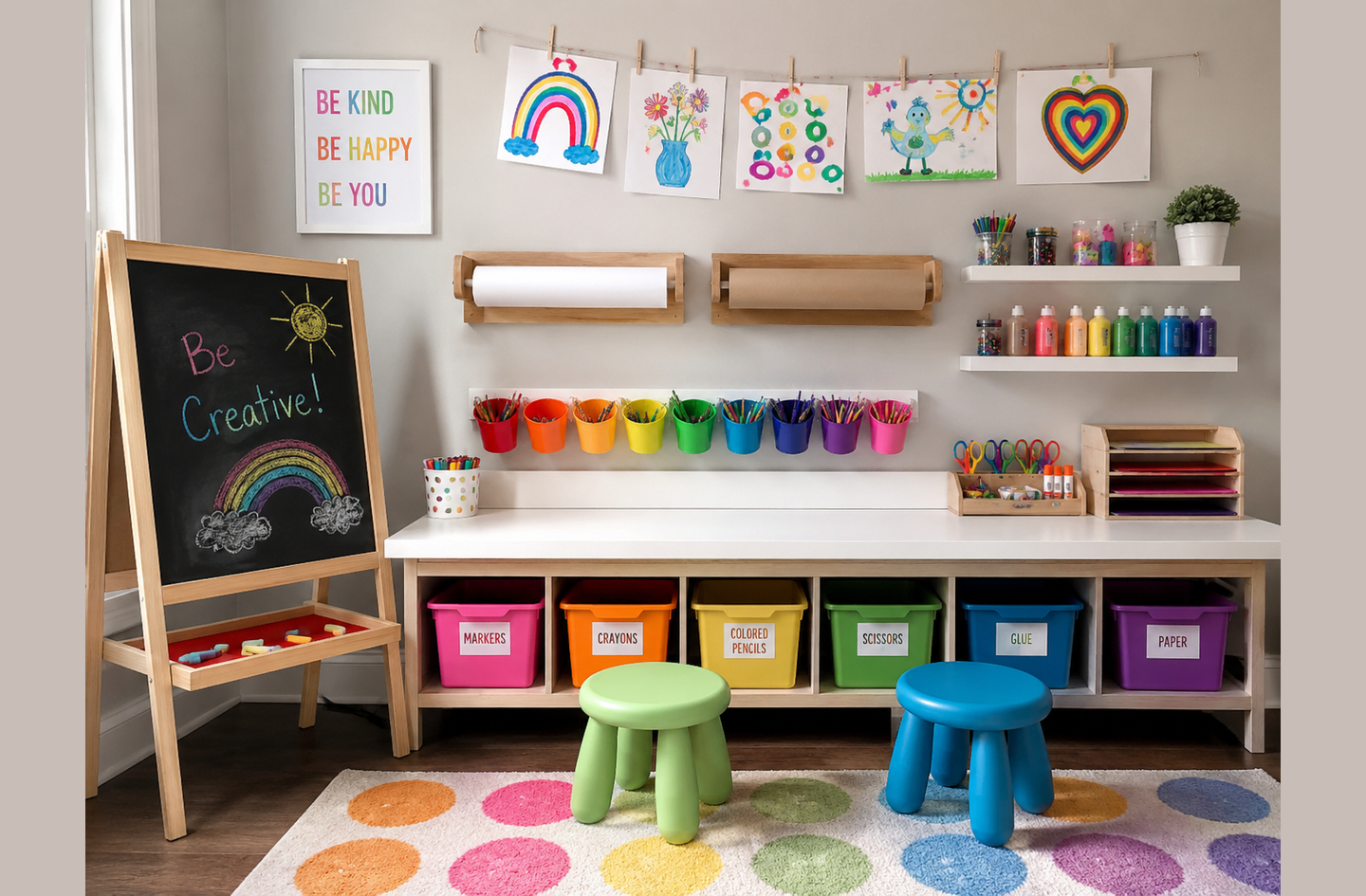
Playroom Architect noted that the labeling information becomes practical only when it influences how a home art station is organized. Rather than placing every marker, paint, glue and craft tool within child reach, the company recommends building access tiers that separate self-serve materials, ask-first supplies and adult-managed backup or specialty items. Age guidance and cautionary labels should determine where a material lives, and organization should keep safety information attached to the product rather than removing labels by decanting supplies into anonymous containers. These principles are detailed in the Playroom Architect Art & Craft Stations Guide.
“A table full of supplies is not the same as a planned art station,” said Oded Feigin, founder and lead author of Playroom Architect. “Product information should decide where something belongs, so the room reinforces the manufacturer’s directions instead of overriding them.”
The company also stressed planning the full creative workflow. Its four-stage approach moving finished work from active project to drying to display to archive is covered in the Playroom Architect Kids Artwork Storage Guide.
Feigin brings B.Sc. and M.Sc. mechanical-engineering training together with residential construction and renovation planning experience, and Playroom Architect frames its credibility as systems-oriented space planning rather than toxicology, medicine or certified child-safety expertise.
Playroom Architect provides expert-led guidance and resources for parents designing safe, functional and developmentally supportive indoor play spaces for children, with an engineering-first approach focused on structural safety, functionality and developmental fit.
###
For more information about Playroom Architect, contact the company here:
Playroom Architect
Oded Feigin
info@playroomarchitect.com
144-42 Jewel Avenue
Flushing, NY 11367
United States

