Nano-Based Water Filtration Market to Reach USD 910.40 Billion by 2035 at 14.57% CAGR
The global nano-based water filtration market was valued at USD 237.454 billion in 2025 and is projected to reach USD

Press Release Disclaimer: This is a press release distributed through the XPR Media network. It has not been independently verified by our newsroom.

The global nano-based water filtration market was valued at USD 237.454 billion in 2025 and is projected to reach USD 267.622 billion by 2026
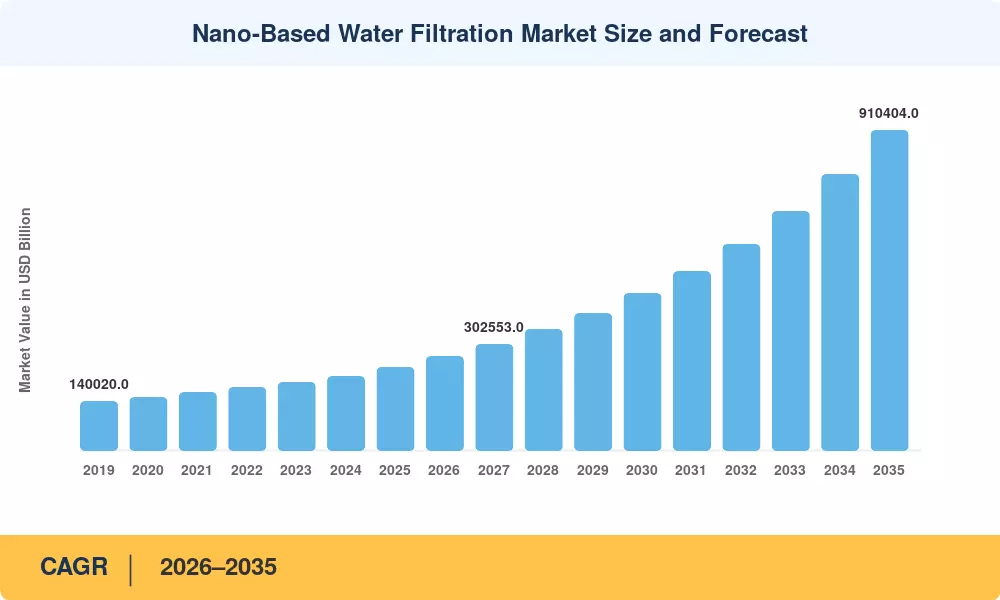
NEW YORK, NY, UNITED STATES, July 29, 2026 /EINPresswire.com/ — The global nano-based water filtration market was valued at USD 237.454 billion in 2025 and is projected to reach USD 267.622 billion by 2026, ultimately growing to USD 910.404 billion by 2035, registering a CAGR of 14.57% during the forecast period (2026–2035).
Market Overview
Nano-based water filtration refers to advanced purification technologies that utilize nanomaterials—such as nanomembranes, carbon nanotubes, nanofibers, and nanoparticles—to remove contaminants from water at the molecular level. These systems leverage the unique physical and chemical properties of materials at the nanoscale (1–100 nanometers) to achieve superior filtration efficiency, higher flux rates, and selective removal of specific pollutants including heavy metals, pathogens, pharmaceutical residues, and emerging contaminants like PFAS. The technology encompasses diverse product types including nanomembrane filters (polymeric and ceramic), carbon nanotube (CNT) filters, nanofiber-based filtration media, and nanoparticle-enhanced adsorption systems, serving applications across municipal water treatment, industrial wastewater treatment, residential purification, and agricultural water treatment.
The market’s expansion is being driven primarily by rising global water scarcity and escalating demand for clean, potable water across both developed and emerging economies. According to the United Nations World Water Development Report, over 2 billion people worldwide lack access to safely managed drinking water, creating sustained demand for advanced filtration solutions. Concurrently, government investments in water infrastructure—including multi-billion-dollar national clean water programs in the United States, China, and India—are channeling significant capital into next-generation purification technologies, of which nanofiltration is a central pillar.
Industry trends indicate a decisive shift toward multifunctional and intelligent filtration systems. First-generation nanomembranes are giving way to multifunctional nanomaterials that combine filtration, disinfection, and pollutant sensing in integrated modules. Graphene oxide membranes, carbon nanotube-based filters, and photocatalytic nano-TiO₂ composites are moving from pilot-scale to commercial production. The convergence of enhanced nanomaterial synthesis and AI-enabled process optimization is expected to produce self-monitoring filtration systems with real-time performance adjustment capabilities, significantly increasing operational efficiency and lowering lifecycle costs.
Technological developments are rapidly expanding the market’s capabilities and reducing costs. OCSiAl’s historic announcement in November 2025 about the opening of its flagship graphene nanotube production plant in Differdange, Luxembourg—which will be the largest in the world—is drastically lowering unit prices and hastening commercial adoption. The supply chain for multi-walled carbon nanotubes has expanded as a result of Birla Carbon’s October 2023 acquisition of Nanocyl SA, strengthening its use in cutting-edge conductivity and filtering applications. Improved nanomaterial synthesis is expected to reduce graphene nanotube costs by more than 30% when OCSiAl’s Luxembourg plant reaches full capacity.
📍 Get Free Sample Report for Detailed Market Insights:
https://www.marketresearchfuture.com/sample_request/68390
Market Segmentation
By Product Type
The market is segmented by product type into Nanomembrane Filters, Carbon Nanotube Filters, Nanofiber Filters, Nanoparticle-Based Filters, and Others. Nanomembrane filters are the market’s leading product segment, accounting for an expected USD 90,233 million in 2025 revenues, driven by their proven effectiveness in large-scale municipal and industrial water treatment and the broadest regulatory approval base. Carbon nanotube (CNT) filters are expected to rise at a compound annual growth rate (CAGR) of roughly 17.8% through 2035 due to advancements in the scalability of graphene nanotube manufacture, propelled by breakthroughs in scalable production and declining unit economics. Nanofiber filters represent USD 42,742 million, serving air-water crossover applications and cost-effective media. Nanoparticle-based filters account for USD 28,495 million, specializing in heavy metal and PFAS adsorption for point-of-use systems.
By Application
Application segmentation covers Municipal Water Treatment, Industrial Wastewater Treatment, Residential Water Purification, Agricultural Water Treatment, and Others. Municipal water treatment is the largest application segment at USD 75,985 million, supported by government mandates worldwide that require advanced contaminant removal capabilities beyond conventional treatment. Industrial wastewater treatment is the fastest-growing application at approximately 16.9% CAGR, reflecting the rapid expansion of manufacturing capacity in Asia-Pacific and the proliferation of stringent zero-liquid-discharge regulations that necessitate high-efficiency nano-filtration solutions. Residential water purification represents USD 52,240 million, driven by growing consumer awareness and point-of-use product proliferation. Agricultural water treatment accounts for USD 26,120 million, addressing irrigation water quality and pesticide/fertilizer remediation.
By End-User
End-user segmentation includes Municipal & Government Bodies, Industrial, Commercial, Residential, and Others. Municipal and government bodies constitute the largest end-user segment at USD 83,109 million, reflecting the dominance of public-sector water infrastructure procurement in driving market demand. Industrial end-users represent USD 71,236 million, driven by process water quality requirements and discharge regulations. The residential segment, while currently the smallest at USD 35,618 million, exhibits the highest growth trajectory at approximately 16.2% CAGR, driven by rising consumer awareness of water quality issues and the increasing availability of affordable, compact nano-filtration units for point-of-use applications.
By Region
Regional segmentation includes North America, Europe, Asia Pacific, South America, and the Middle East and Africa. North America is the dominant region with USD 83,109 million in 2025. Asia-Pacific is the fastest-growing region at approximately 17.5% CAGR. Europe represents USD 64,113 million. South America accounts for USD 16,622 million, and the Middle East & Africa represents USD 14,247 million.
🛒 You can buy this market report at:
https://www.marketresearchfuture.com/checkout?currency=one_user-USD&report_id=68390
Regional Analysis
North America
North America leads the global market with an estimated USD 83,109 million in 2025 revenues, driven by the United States’ advanced regulatory environment, robust municipal spending, and early adoption of nanotechnology-enabled water treatment. The United States accounts for USD 66,487 million, with the EPA’s aggressive PFAS action plan serving as a significant catalyst for nano-filtration deployment, as conventional activated carbon systems are less effective against short-chain PFAS variants. The Bipartisan Infrastructure Law allocates over USD 55 billion for water and wastewater infrastructure, with a sizeable amount designated for cutting-edge treatment technologies. Canada contributes USD 12,472 million, with federal water quality modernization and Indigenous community water programs stimulating demand for compact nano-filtration units suitable for remote deployment. Mexico’s industrial corridor wastewater treatment expansion adds USD 4,150 million.
Europe
Europe represents the second-largest regional market at approximately USD 64,113 million in 2025. The revised EU Drinking Water Directive, which tightened standards for emerging contaminants including microplastics and endocrine disruptors, is driving utilities across the continent to invest in advanced nano-filtration upgrades. Germany leads European adoption at USD 16,670 million through its industrial water recycling mandates and integration of smart nano-filtration monitoring within Industrie 4.0 frameworks. The United Kingdom contributes USD 11,390 million, with the Thames Tideway programme catalyzing broader water infrastructure modernization. France represents USD 10,260 million, driven by EU compliance and agricultural runoff remediation. Italy accounts for USD 7,700 million, addressing Mediterranean water stress and tourism sector standards.
Asia-Pacific
Asia-Pacific is the fastest-growing region with a projected CAGR of approximately 17.5% over 2026–2035, driven by the confluence of rapid urbanization, massive government water infrastructure programs, and accelerating industrial growth. China accounts for USD 23,746 million, with its 14th Five-Year Plan containing significant measures for improving industrial wastewater treatment and urban water supply, alongside zero-liquid-discharge mandates for industrial facilities. India represents USD 14,247 million, with the Jal Jeevan Mission aiming to provide piped water connections to every rural family, opening up a multibillion-dollar addressable market for point-of-use and community-scale nano-filtration technologies. Japan contributes USD 8,906 million, driven by aging infrastructure replacement and advanced membrane R&D. South Korea accounts for USD 5,342 million, with semiconductor fab water recycling and K-water modernization programs.
South America
South America accounts for approximately USD 16,622 million in 2025, with Brazil as the primary market at USD 8,311 million. The region’s growth trajectory (14.0% CAGR) is supported by expanding municipal water access programs, mining sector wastewater treatment requirements, and development bank-financed infrastructure projects. Mexico contributes USD 3,325 million, driven by industrial corridor development. Argentina accounts for USD 1,995 million, with mining sector wastewater and agricultural remediation driving demand. The privatization of major utilities such as SABESP in Brazil is expected to accelerate technology adoption as private operators pursue efficiency improvements through advanced filtration.
Middle East & Africa
The Middle East & Africa market, valued at approximately USD 14,247 million in 2025, is driven by acute water scarcity and substantial investments in desalination infrastructure, particularly in the GCC states. GCC countries account for USD 7,124 million, with nano-filtration technologies increasingly used as pre-treatment stages in desalination plants, improving membrane longevity and reducing energy consumption. South Africa represents USD 2,849 million, addressing municipal water quality crises and mining remediation. In Sub-Saharan Africa, donor-funded and NGO-supported water access programs are creating demand for low-maintenance, high-efficacy nano-filtration solutions suitable for decentralized deployment.
Competitive Landscape / Key Players
The global nano-based water filtration market exhibits moderate concentration, with Tier 1 players—defined as companies with estimated annual nano-filtration revenues exceeding USD 5 billion—collectively commanding approximately 43.2% of market share. Key companies operating in this market include OCSiAl (~8.5% share), Cabot Corporation (~7.8%), Arkema (~7.2%), ZEON Corporation (~6.5%), Nanocyl SA (Birla Carbon) (~5.5%), Canatu (~3.8%), Nanografi (~3.2%), NoPo Nanotechnologies (~2.8%), AdNano Technologies Pvt Ltd (~2.5%), and Carbon Solutions, Inc (~2.2%).
Strategic developments in the market include significant capacity expansions and acquisitions. In November 2025, OCSiAl announced the signing of a long-term land lease for the development of its flagship graphene nanotube production center in Differdange, Luxembourg, which is planned to become a scalable facility serving as a development hub for European advanced materials. In October 2023, Birla Carbon acquired Nanocyl SA, integrating its expertise in multi-walled carbon nanotube production into Birla Carbon’s extensive global manufacturing and distribution network to expand its presence in the energy systems market.
Competitive differentiation increasingly hinges on nanomaterial production capacity, intellectual property portfolios, geographic distribution networks, and the ability to provide integrated filtration-plus-monitoring solutions. Strategic M&A activity signals a consolidation trend that is expected to increase top-five player concentration to over 50% by 2030, with differentiation increasingly driven by proprietary nanomaterial formulations, manufacturing scale, and embedded digital monitoring capabilities.
Latest Industry News & Developments
Recent industry developments highlight the ongoing transformation of the nano-based water filtration market toward scalable production, advanced materials integration, and sustainability. In November 2025, OCSiAl announced the signing of a long-term land lease for the development of its flagship graphene nanotube production center in Differdange, Luxembourg. Upon completion, this deep-tech manufacturing center is planned to become a scalable facility intended to serve as a development hub for European advanced materials, specifically targeting the electric vehicle battery, automotive, consumer electronics, and specialized tires markets. The facility’s European location positions OCSiAl to meet growing global and regional demand for single-walled carbon nanotubes.
In October 2023, Birla Carbon acquired Nanocyl SA, a global leader in carbon black and specialty carbons, to expand Birla Carbon’s presence in the energy systems market, particularly for lithium-ion battery applications. The acquisition integrates Nanocyl’s expertise in multi-walled carbon nanotube (MWCNT) production and functionalization into Birla Carbon’s extensive global manufacturing and distribution network, creating a comprehensive portfolio aimed at accelerating the electrification of transportation.
Industry observers view the Nanocyl acquisition as a bellwether for further consolidation in the advanced materials sector, while OCSiAl’s Luxembourg investment signals confidence in sustained demand growth across multiple high-value applications, including water filtration where CNT-enhanced membranes offer superior flux rates and contaminant rejection.
Market Challenges & Opportunities
Key restraints facing the nano-based water filtration market include high production and capital costs, with the production of nanomaterials requiring specialized synthesis processes that entail significant energy consumption and high-purity feedstock requirements. Capital expenditure for nano-filtration manufacturing facilities remains substantially above that for conventional polymer membrane plants, creating a barrier to entry for smaller firms and limiting price competitiveness in cost-sensitive markets. While ongoing R&D investments are expected to achieve economies of scale and reduce per-unit costs by an estimated 30–40% by 2030, the near-term cost premium continues to constrain adoption rates, particularly in Latin America, Sub-Saharan Africa, and parts of Southeast Asia where municipal budgets are limited.
Emerging opportunities in the market are substantial and diverse. Rapid urbanization and industrial wastewater generation in emerging nations are producing massive amounts of industrial and municipal wastewater requiring improved treatment before release or reuse. The industrial wastewater treatment segment—estimated to be worth USD 66,487 million in 2025—is expected to increase at a CAGR of roughly 16.9%, resulting in a cumulative incremental revenue opportunity of over USD 180 billion. Zero-liquid-discharge regulations in China, India, and some regions of the EU are further accelerating the need for high-efficiency nano-filtration modules that can treat and recover water from difficult industrial waste streams.
Future potential lies in the development of self-monitoring filtration systems with real-time performance adjustment capabilities, enabled by AI and advanced sensor integration. The convergence of improved nanomaterial synthesis and AI-enabled process optimization is expected to significantly increase operational efficiency and lower lifecycle costs. Circular economy frameworks that support resource recovery from wastewater and water reuse will drive demand for high-selectivity nano-filtration membranes that can recover valuable elements from effluent streams. Companies that invest in scalable, modular nano-filtration systems designed for industrial applications and establish early positions in emerging mining regions through joint ventures or local manufacturing are well-positioned to capture a sizable chunk of this market over the next ten years.
To explore more market insights, visit us at:
https://www.marketresearchfuture.com/reports/nano-based-water-filtration-market-68390
Final Market Summary
The nano-based water filtration market is positioned for exceptional growth through 2035, driven by rising global water scarcity, government investments in water infrastructure, rapid urbanization, and stringent regulatory mandates on emerging contaminants. The projected valuation of USD 910.40 billion reflects rapidly expanding adoption across municipal, industrial, residential, and agricultural applications, with the market transitioning from first-generation nanomembranes to multifunctional, intelligent filtration systems.
The medium-term growth outlook remains exceptionally strong, with the market registering a robust CAGR of 14.57% during the forecast period. North America will continue to maintain market leadership through stringent EPA regulations and municipal infrastructure modernization, while Asia-Pacific emerges as the fastest-growing region driven by massive government water programs and industrial expansion. The ongoing development of carbon nanotube filters, graphene oxide membranes, and AI-enabled monitoring systems will continue to expand market possibilities and applications.
Long-term industry potential extends significantly beyond the current forecast horizon. The convergence of falling nanomaterial manufacturing costs, growing municipal adoption in developing economies, and stricter worldwide water quality laws will sustain double-digit growth through the end of the forecast period. Regulatory frameworks on PFAS, microplastics, and pharmaceutical residues will continue to create compliance-driven demand that conventional technologies cannot satisfy, effectively mandating the transition to nano-enabled solutions. Circular economy initiatives will drive demand for resource recovery and water reuse, creating new application areas for high-selectivity nano-filtration membranes. Manufacturers that successfully develop scalable nanomaterial production capabilities, invest in integrated digital monitoring platforms, and establish local manufacturing and service networks in high-growth regions will capture substantial value in this rapidly evolving market. The transformation of water filtration from conventional treatment to nanotechnology-enabled purification represents a fundamental advancement in addressing global water security challenges, enabling the removal of emerging contaminants and the sustainable management of increasingly scarce water resources for future generations.
More Related Reports from MRFR Library:
Electric Lawn Mower Market: https://www.marketresearchfuture.com/reports/electric-lawn-mower-market-29643
Hazardous Waste Management Market: https://www.marketresearchfuture.com/reports/hazardous-waste-management-market-29821
Electric Power Tool Market: https://www.marketresearchfuture.com/reports/electric-power-tool-market-29989
High Pressure Washer Market: https://www.marketresearchfuture.com/reports/high-pressure-washer-market-29998
Electrocoagulation Market: https://www.marketresearchfuture.com/reports/electrocoagulation-market-30457
Elevated Water Storage Tanks Market: https://www.marketresearchfuture.com/reports/elevated-water-storage-tanks-market-30464
Press Machine Market: https://www.marketresearchfuture.com/reports/press-machine-market-30473
Water Test Kit Market: https://www.marketresearchfuture.com/reports/water-test-kit-market-30659
Mezzanine Floor Market: https://www.marketresearchfuture.com/reports/mezzanine-floor-market-30669
Micromachining Market: https://www.marketresearchfuture.com/reports/micromachining-market-31029
Larry Wilson
WantStats Research And Media Pvt. Ltd.
+1 855-661-4441
email us here
Legal Disclaimer:
EIN Presswire provides this news content “as is” without warranty of any kind. We do not accept any responsibility or liability
for the accuracy, content, images, videos, licenses, completeness, legality, or reliability of the information contained in this
article. If you have any complaints or copyright issues related to this article, kindly contact the author above.

Media gallery