Flexcompute Introduces Physics Twin for Space Plume Impingement to Assess Thruster Effects in Docking and Refueling
BOSTON, Nov. 4, 2026

Press Release Disclaimer: This is a press release distributed through the XPR Media network. It has not been independently verified by our newsroom.
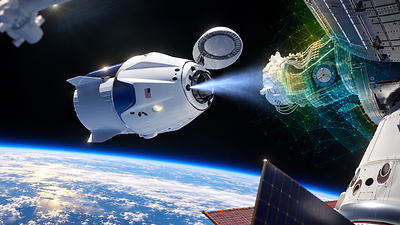

Flexcompute Introduces Physics Twin for Space Plume Impingement to Assess Thruster Effects in Docking and Refueling
PR Newswire
BOSTON, Nov. 4, 2026
Powered by Flexcompute’s Physics World Model, new Physics Twin helps mission teams assess plume effects across more close-range maneuvers with less compute than DSMC
BOSTON, Nov. 4, 2026 /PRNewswire/ — As space missions expand to include refueling, servicing and autonomous docking, mission teams need to understand how thruster plumes could affect nearby spacecraft. Flexcompute, a frontier AI lab building a Physics World Model, today introduced the Physics Twin for Space Plume Impingement. It enables engineers and AI agents to assess plume effects across a wider range of maneuvers while using less compute than traditional Direct Simulation Monte Carlo (DSMC) methods.
Plume impingement occurs when thruster exhaust strikes a nearby vehicle. It can push or heat that vehicle, potentially setting it tumbling, eroding its surfaces or contaminating its sensors. These effects matter most during rendezvous and proximity operations (RPO), when a single thruster firing can affect another spacecraft.
DSMC is a well-established method for analyzing rarefied plume flows, but its computational cost can limit how many scenarios teams can evaluate. Through Tokenized Physics, the Physics Twin brings AI speed and physics accuracy together. It combines neural networks and a novel Boltzmann solver in one model that handles complex plume physics efficiently while delivering DSMC-class accuracy. Unlike surrogate models, Flexcompute’s approach is grounded in physics, so results hold up on new plume conditions and geometries without retraining for each case.
“Flexcompute’s Tokenized Physics approach has the potential to speed up analysis ~200X compared with Direct Simulation Monte Carlo, allowing us to explore a much larger range of plume interaction scenarios to support mission demands,” said Dr. Han Park, Vice President of AI Integration, Space Systems, Northrop Grumman. “For close-proximity maneuvers like docking and refueling where Northrop Grumman is leading the way and performing unprecedented dynamic space operations, that means we can analyze far more approach paths and firing sequences and see how each one will affect the vehicles involved.”
The Physics Twin for Space Plume Impingement is a working model of a team’s spacecraft and its plume environment that engineers and AI agents can question, test and improve. It makes routine the questions that were once too costly to ask: What is the safest way to dock with another spacecraft? Will thruster plumes damage or contaminate critical sensors? Answering them earlier gives teams confidence in every mission-critical maneuver.
“As spacecraft take on more autonomous, close-proximity operations, mission teams need confidence in the physics behind every maneuver,” said Vera Yang, President and Co-founder of Flexcompute. “Our Physics Twin for Plume Impingement gives engineers and AI agents a way to evaluate plume effects across mission scenarios before flight. It’s part of our growing suite of Physics Twins, from spacecraft plume interactions to warpage in advanced chip packaging, that bring our Physics World Model into real-world engineering decisions.”
The Physics Twin for Space Plume Impingement is available now. Learn more about Flexcompute’s Physics Twins.
About Flexcompute
Flexcompute is a frontier AI lab building a Physics World Model that bridges data-driven AI and the laws of physics. Founded by researchers from Stanford and MIT, its team of more than 70 PhDs develops GPU-native solvers for fluid dynamics, electromagnetics, structures, and heat. Through Tokenized Physics, Flexcompute builds both neural networks and first-principles physics directly into its Physics World Model. This creates a verification layer that grounds AI predictions in trusted physics and helps engineers and AI agents evaluate how designs will perform before they are built. Engineering teams at more than 250 companies across aerospace, automotive, defense, semiconductors, photonics, and advanced manufacturing use Flexcompute to evaluate, explore, and optimize designs, allowing them to innovate with confidence. Learn more at flexcompute.com.
Media Contact
Silvie Casanova
Flexcompute
silvie.casanova@flexcompute.com

 View original content to download multimedia:https://www.prnewswire.com/news-releases/flexcompute-introduces-physics-twin-for-space-plume-impingement-to-assess-thruster-effects-in-docking-and-refueling-302929573.html
SOURCE FlexCompute Inc.