Multi-scale hybridization and chemical bonding enable ultra-durable flexible strain sensors
GA, UNITED STATES, August 12, 2026 /EINPresswire.com/ -- Using a dual-modification strategy of in-situ silica and

Press Release Disclaimer: This is a press release distributed through the XPR Media network. It has not been independently verified by our newsroom.
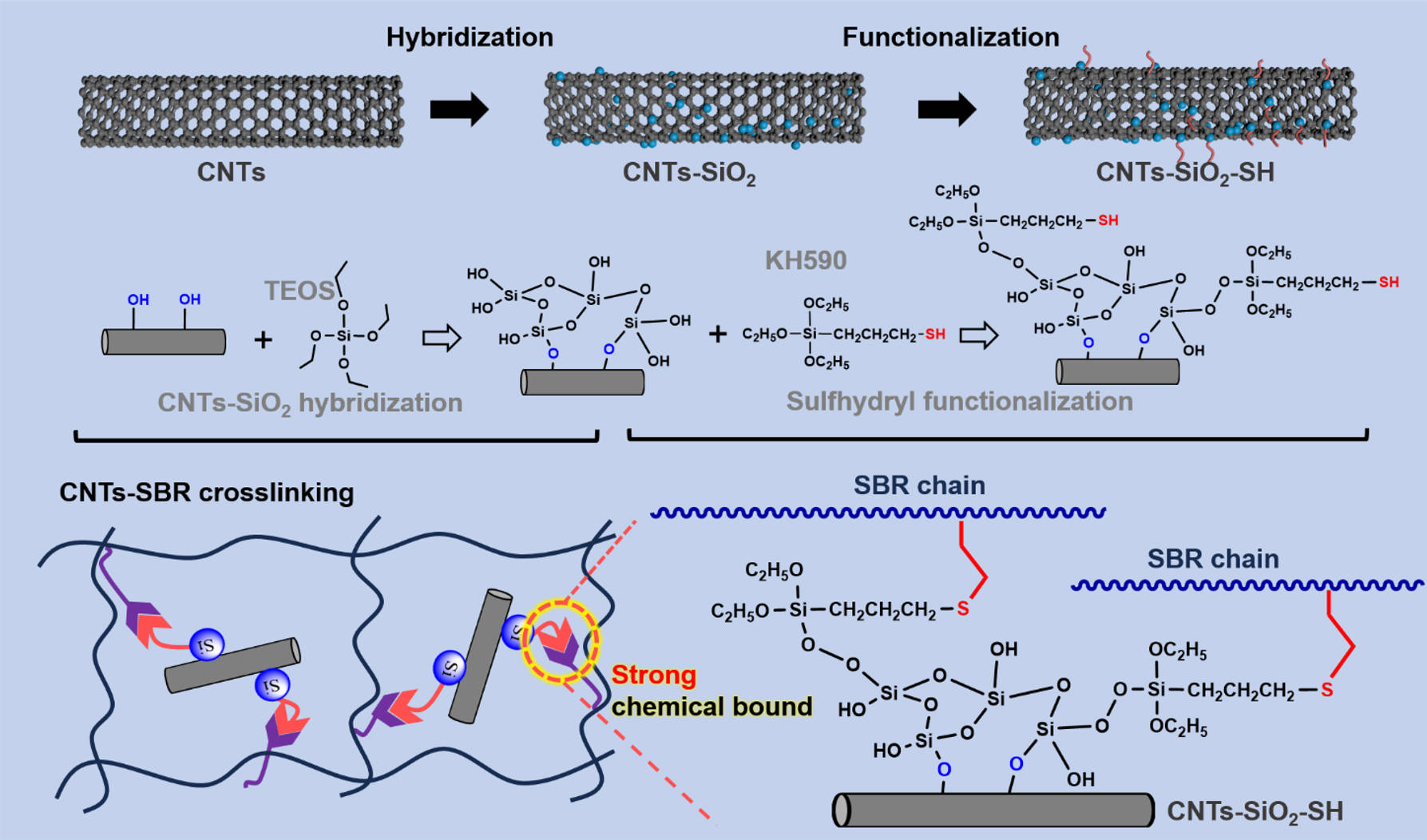

GA, UNITED STATES, August 12, 2026 /EINPresswire.com/ — Using a dual-modification strategy of in-situ silica and mercaptosilane alongside a covalent co-vulcanization network, the study constructs ultra-durable carbon nanotube strain sensors. This design effectively suppresses filler secondary agglomeration. Benefiting from this robust chemical bonding, the sensor maintains exceptional signal stability without significant drift after 15,000 stretch cycles, achieving industry-leading durability under extreme acidic, alkaline, and saline environments.
Wearable strain sensors have made significant advances in detecting both subtle physiological signals, such as heartbeats and pulses, and larger movements, such as elbow bending. However, maintaining their stability over prolonged use and under changing environmental conditions remains a major barrier to their practical application. To address this challenge, researchers developed a synergistic strategy that combines filler hybridisation with interfacial chemical bonding in styrene–butadiene rubber (SBR) and carbon nanotube (CNT) composites.
“By growing silica in situ on the CNTs and grafting active thiol groups onto their surfaces, we created a covalent co-vulcanisation network with the rubber matrix,” shares senior and co-corresponding author Kai Liu. “This network securely anchors the conductive pathways and helps prevent the secondary agglomeration of conductive fillers.”
Conventional wearable strain sensors suffer from performance degradation during long-term cyclic stretching because weak van der Waals forces cause conductive fillers to re-aggregate. “By replacing these relatively weak physical interactions with a robust, chemically crosslinked network, the new approach maintained stable sensing performance over 15,000 tensile cycles,” explains Liu.
The resulting sensors also operated reliably under harsh environmental conditions, including exposure to strong acids, strong bases and highly saline environments.
Notably, the team’s method employs a two-step functionalization process with TEOS and KH590, which unexpectedly streamlined filler dispersion and lowered the Payne effect.
“By moving beyond physical blending and establishing true chemical bonding between the filler and the elastomer matrix, we can ensure structural integrity under prolonged mechanical loading,” says co-corresponding author Yudong Liu.
“This multi-scale synergy bridges the gap between high sensitivity and exceptional durability, offering a practical solution for reliable health monitoring and high-risk industrial scenarios,” adds co-author Xiaokang Zhai.
References
DOI
10.1016/j.wees.2026.04.001
Original Source URL
https://doi.org/10.1016/j.wees.2026.04.001
Funding information
This work is supported by National Natural Science Foundation of China (52303216), Shandong Provincial Higher Education Institutions Youth Innovation Technology Support Program (2024KJH106), Natural Science Foundation of Shandong Province (ZR2025QB48). K.L. would like to acknowledge the support from the Taishan Scholars Young Experts Program of Shandong Province
Lucy Wang
BioDesign Research
email us here
Legal Disclaimer:
EIN Presswire provides this news content “as is” without warranty of any kind. We do not accept any responsibility or liability
for the accuracy, content, images, videos, licenses, completeness, legality, or reliability of the information contained in this
article. If you have any complaints or copyright issues related to this article, kindly contact the author above.

Media gallery